
Flags Featuring the Union Jack: Why So Many Share One Canton
Flags featuring the Union Jack explained: how the 1801 design was built, which countries and ensigns still carry the canton, and how to fly it the right way up.
By the Flag Maker team
Flags featuring the Union Jack all share one corner because they were once flown under British authority, at sea or on land. The Union Jack sits in the canton, the upper quarter nearest the pole, on the national flags of Australia, New Zealand, Fiji and Tuvalu, on the state flag of Hawaii, and on most British overseas territory flags.
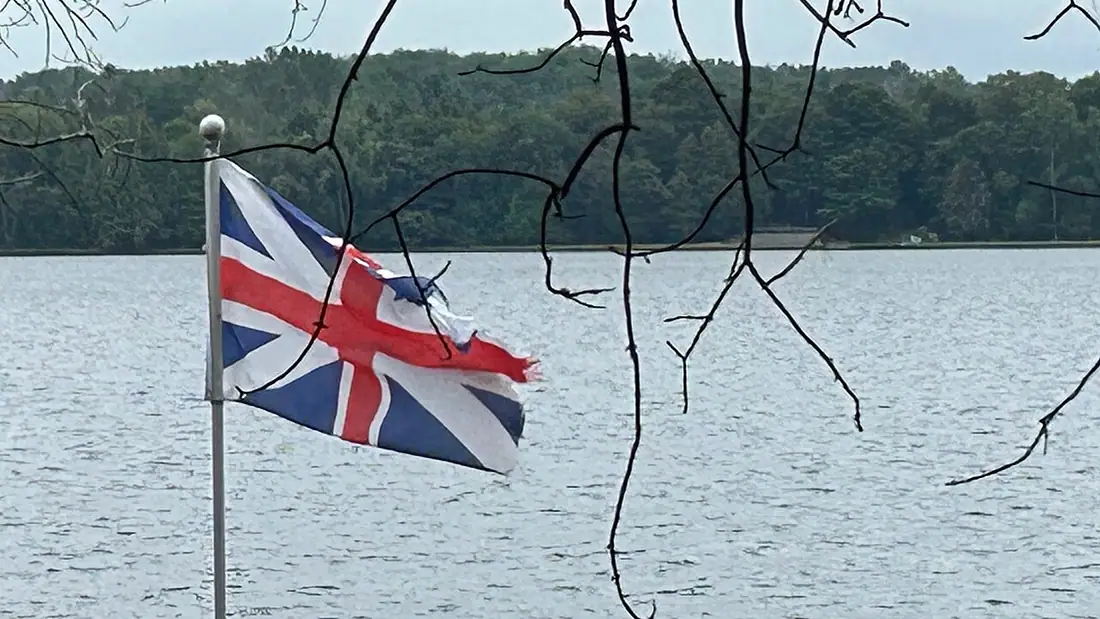
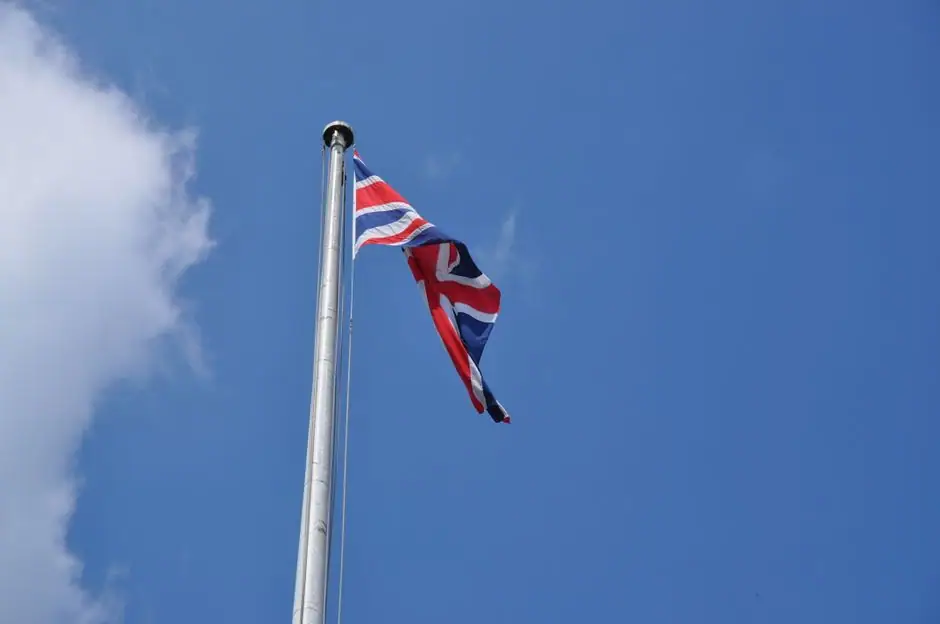
That corner is a historical signature rather than decoration. Here is how the design was built, what it means when it turns up on somebody else’s flag, and how to borrow the idea for your own.
What the Union Jack is made of: three crosses in one field
The British flag design stacks three crosses on a blue field.
- The cross of Saint George, an upright red cross, for England.
- The saltire of Saint Andrew, a white diagonal cross on blue, for Scotland.
- The saltire of Saint Patrick, a red diagonal cross, for Ireland.
A saltire is a diagonal cross running corner to corner. The blue background comes from Scotland’s flag, which is why the field is blue and not white.
The thin white lines beside the red are not stripes in their own right. They are fimbriation, narrow edging that stops red sitting directly on blue. Old heraldic practice avoided colour touching colour, and the white keeps every shape readable from a distance.
Wales is missing. When the first union flag was drawn, Wales had long been joined to the Kingdom of England, so there was no separate Welsh cross to include. The red dragon flag came into official use much later.
How the 1801 design was assembled, and why it is not symmetrical
The union flag design arrived in two stages. In 1606, after James VI of Scotland also became king of England, the crosses of Saint George and Saint Andrew were combined into a single flag for ships. In 1801, when Great Britain and Ireland were joined by Act of Union, the red saltire of Saint Patrick was added and the modern flag appeared.
Fitting two diagonal crosses into one space caused the problem. Putting the red saltire straight on top of the white one would have made Ireland look like it outranked Scotland. So the red was counterchanged: it is offset from the centre of each diagonal arm, with white on both sides of it.
The result is a flag with no mirror symmetry. Look at the top half next to the pole and the broad white diagonal sits above the red. Look at the fly half and it flips. Wikipedia’s article on the Union Jack sets out the exact construction and widths.
Proportions shift with use as well. On land the Union Flag is usually made 3:5, while at sea it is 1:2, which is longer and thinner. Our guide to flag ratios and what they mean explains why the same design can come in two shapes.
Which flags still carry it, and what the canton means
The canton is the upper rectangle beside the hoist, and it reads as the senior position on a flag. A flag in that spot says something outranks or came before the rest of the design.
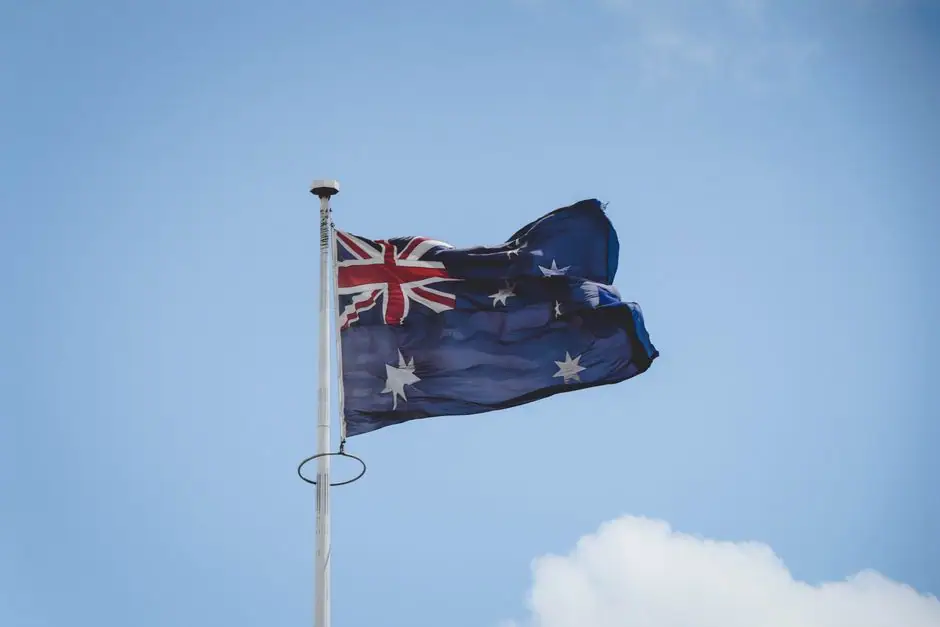
Flags still using it include:
- Australia, New Zealand, Fiji and Tuvalu.
- Niue and the Cook Islands.
- Hawaii, the only US state flag with it.
- Overseas territories such as Bermuda, the Cayman Islands, the Falkland Islands, Anguilla, Montserrat, the British Virgin Islands, Turks and Caicos, Saint Helena and Pitcairn.
- The Canadian provinces of Ontario and Manitoba.
Plenty of places have dropped it. Canada retired the Canadian Red Ensign for the maple leaf flag in 1965. South Africa’s old flag carried a small Union Jack in its centre band until 1994. Hong Kong flew a blue ensign until 1997. The canton tends to go when a country wants a design that stands alone.
If the corner vocabulary is new to you, the guide to the parts of a flag names the hoist, fly, field and canton with a diagram.
Ensigns, blue ensigns and state badges
Most of these flags descend from British ensigns. An ensign is a flag flown at the stern of a ship to show nationality, and Britain settled on three.
| Ensign | Field | Who flies it |
|---|---|---|
| White Ensign | White with a red Saint George cross | Royal Navy |
| Red Ensign | Plain red | British merchant and civil vessels |
| Blue Ensign | Plain blue | Government service, and the base for territory flags |
Searches for a blue union jack usually land on the Blue Ensign. Take a plain blue field, put the Union Jack in the canton, add a colony or territory badge in the fly half, and you have the pattern behind most of the flags listed above. Bermuda is the odd one out, using a red ensign instead.
That fly badge is where local identity lives. It is often a shield or full coat of arms, which is why so many of these flags look busy up close and nearly identical far away.
Flying it the right way up
The Union Jack has a correct orientation, and it gets flown upside down in public more often than you would expect.
The rule: on the half nearest the pole, the wide white diagonal must be above the red one. Put another way, the broad white band runs up from the bottom corner by the pole toward the centre. Guidance from the Flag Institute covers this and other points of British flag etiquette.
One quick check. Find the top corner beside the pole and trace the diagonal. White on top, red below. If the red is on top, the flag is reversed.
Borrowing the idea: using a canton in your own design
A canton is a useful device when a flag needs to say two things at once. One shape for the larger group, one field for the thing being named.
Keep it to roughly a quarter of the flag, reaching from the hoist to the centre of the field and down to the midpoint. Any smaller and it reads as a stray mark. Any larger and it fights the main design.
Contrast decides whether it works. A dark canton on a light field, or the reverse, holds its shape when the flag hangs limp. The five rules for good flag design apply here too: simple shapes, few colours and no lettering.
Try the design yourself
The free flag maker on the FlagMakerOnline home page lets you drop in a canton, place crosses and saltires, and see how your flag looks at small sizes before you commit to it.
Frequently asked questions
Why do Australia and New Zealand have the British flag on theirs?
Both were British colonies that became self governing, and both built their national flags on the British blue ensign instead of starting over. Australia added the Commonwealth Star and the Southern Cross. New Zealand kept four red stars of the Southern Cross. The canton stayed as a link to the Crown, which both countries still share.
Is the Union Jack the same thing as the Union Flag?
They are two names for one flag. Union Flag is the older and more formal term, and Union Jack is the common one. The jack part comes from naval use, where a jack is a small flag flown at the bow of a ship. Both names are accepted in Britain today, including by flag scholars.
Which flag has a yellow field with the Union Jack?
Niue, a self governing island in free association with New Zealand. Its flag puts the Union Jack in the canton on a plain yellow field, with five stars added inside the canton itself. The yellow stands for the warmth of the island and its friendship with New Zealand, which makes it the most unusual flag in the group.
Can I put a Union Jack style canton in my own flag design?
The Union Jack design is centuries old, so it is not under copyright. Rules about using a national flag in logos, products or trademarks vary from country to country, so check local law before selling anything. For a club, family or fictional flag, a canton of your own shapes and colours avoids the question entirely.